

Revolutionizing School Registration: A Smart Data Topology for SD Negeri 5 Yehembang
Are centralized systems always better? When it comes to something as critical as new student registration, maybe not. Today, we look at a brilliant benchmark—the data topology implemented by SD Negeri 5 Yehembang—and compare it to the conventional centralized model. This distributed approach provides massive benefits in efficiency and data accuracy.
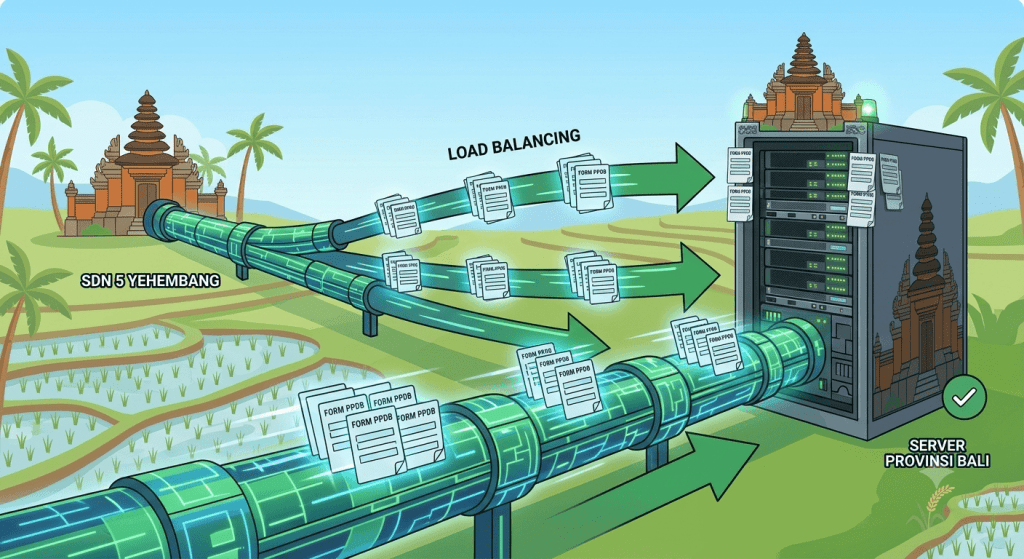
As detailed in the comparison diagram (edited-image.jpg), this innovative model leverages a school-based system to distribute the load and ensure data integrity from the ground up.
H1: The Pitfalls of Conventional Centralization
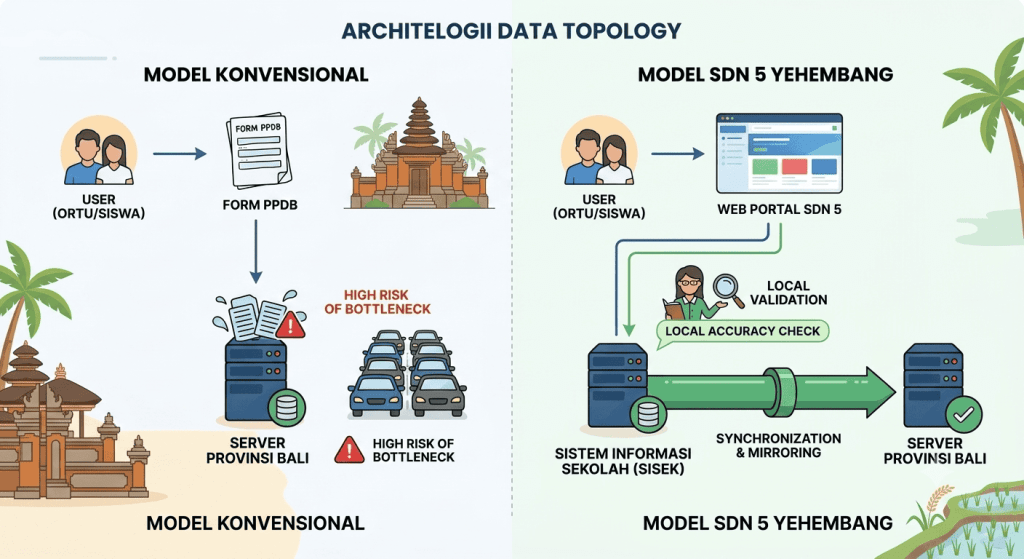
Let’s first look at the traditional method shown on the left side of Architelogi image.jpg.
- Direct User Input to Central Server: In this conventional model, parents or prospective students directly input their data into a single central Provincial Education Department server. This seems straightforward, but it creates several major issues.
- High Risk of Traffic Congestion: When thousands of users across the entire province try to input data simultaneously, the central server inevitably slows down or crashes. The visual icon of cars in gridlock perfectly illustrates this bottleneck. It causes frustration and delays for everyone.
- Data Correction Nightmare: Errors are bound to happen during manual data input. In a purely centralized system, correcting a simple error (like a misspelled name or wrong address) is incredibly difficult once the data is deep within the central database, often requiring lengthy administrative processes at the provincial level.
H2: The SD Negeri 5 Yehembang School-First Approach
Now, contrast this with the streamlined model from SD Negeri 5 Yehembang (seen on the right of edited-image.jpg). This system introduces a crucial and empowering intermediary step: local school involvement.
- Local User Portal: Users access a school-specific web portal using a laptop or smartphone. This portal is integrated with the school’s own Information System (SISEK).
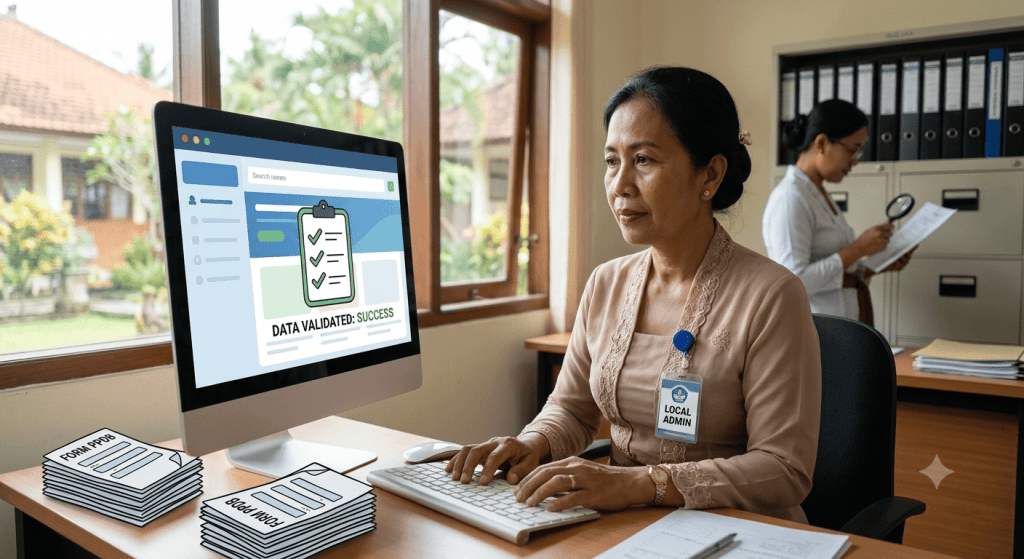
- Local Data Assessment and Validation: This is the game-changer. Data does not go directly to the province. Instead, it is validated locally by a team of school administrators and teachers who understand the local context and can immediately spot obvious errors. They can verify details, ensure required documents are complete, and even check against existing local records before the data proceeds.
- Real-time Synchronization & Mirroring: Once the data is validated and ‘clean’ at the school level, the school system automatically synchronizes and mirrors it directly to the Provincial Education Department server. This connection is efficient, direct, and real-time.
H3: Key Benefits and Proven Efficiency
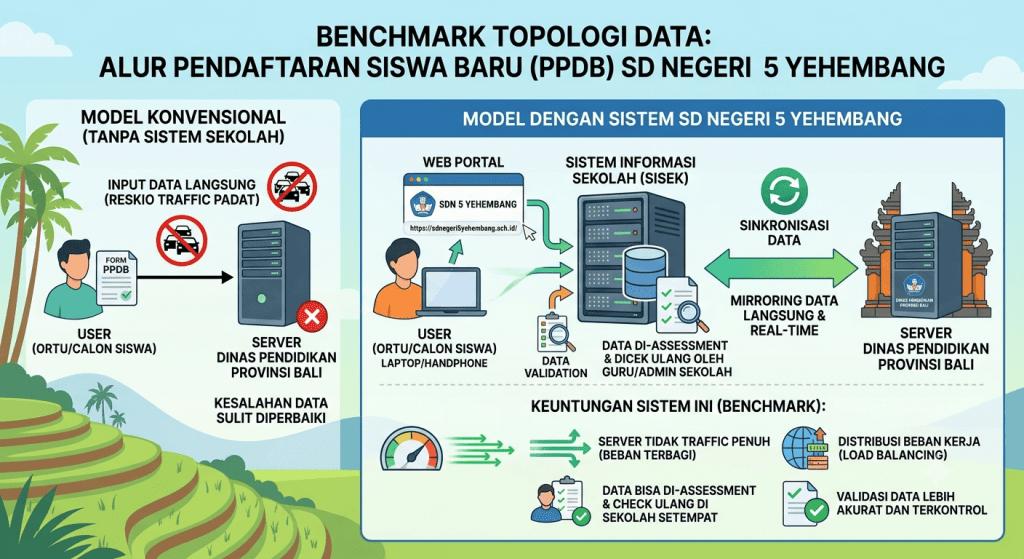
The advantages of this distributed approach are massive, as summarized on the bottom right of edited-image.jpg:
- Server Load Management (Prevents Congestion): By handling the initial input, validation, and processing at the school level, the central Provincial server’s load is significantly reduced. This load sharing prevents the data ‘traffic jams’ that cripple central systems.
- Unmatched Data Accuracy: Local validation by people with a direct stake in the data’s correctness (the school staff) leads to much cleaner data. School staff can use local knowledge for context-aware validation.
- Systemic Load Balancing: The entire provincial educational data network operates more efficiently. The work of processing thousands of registrations is distributed across dozens of local school systems, rather than being a single point of failure at the center.
- Controlled Data Validation: Local schools are empowered with controlled data validation tools. This makes the overall provincial data pool more robust, reliable, and trustworthy.
Conclusion:
SD Negeri 5 Yehembang’s model isn’t just an efficient way to handle registrations; it’s a model for smart e-governance in education. By pushing data control and validation to the edge (the school level), they have created a faster, more accurate, and less stressful process for students, parents, and administrators alike. This is truly a data topology benchmark that other educational systems should study and adopt.ions to securing IT networks.